
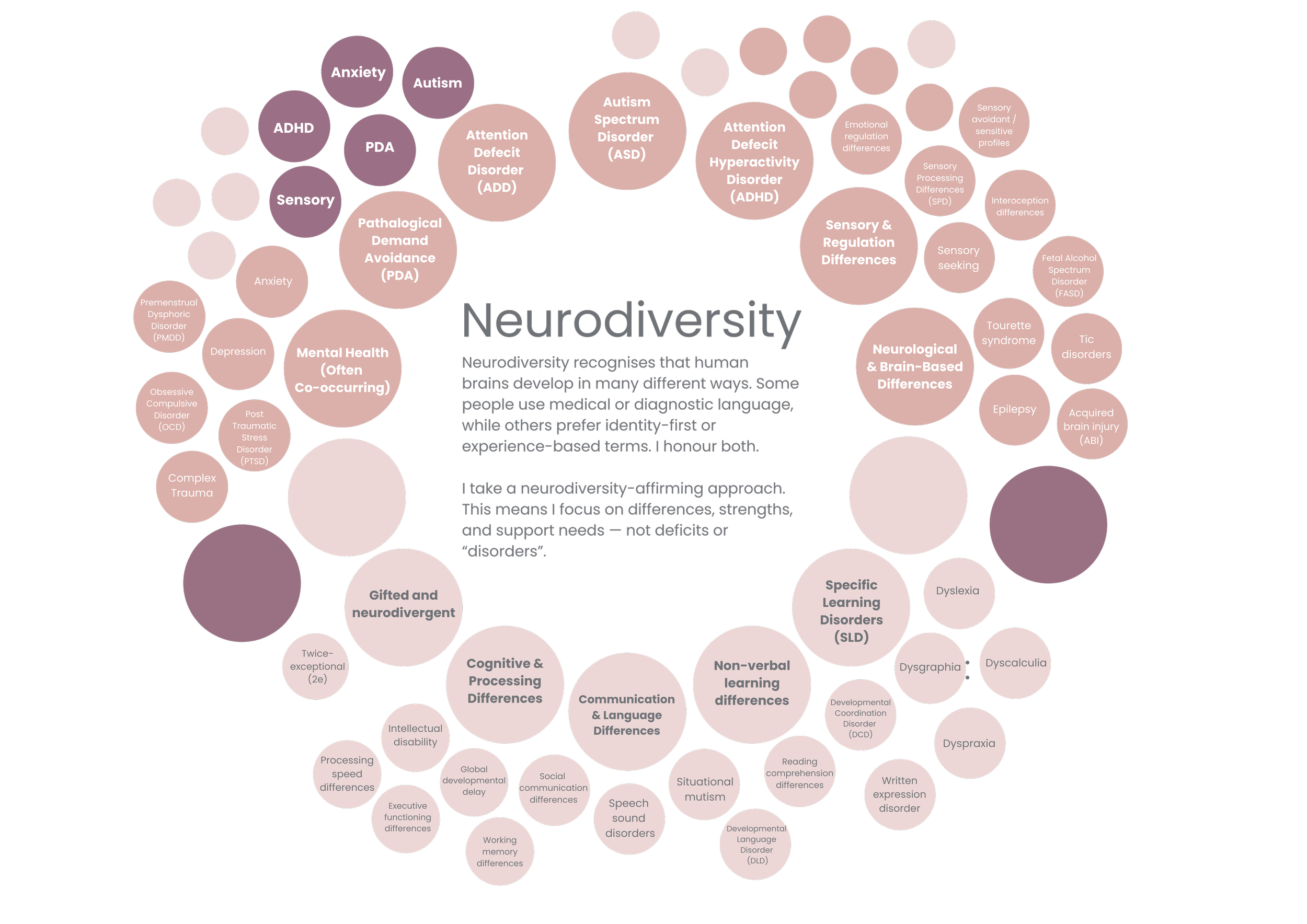
Affirming Neurodiversity and Learning Differences
Understanding Different Thinking, Learning, and Neurodiverse Profiles
Everyone experiences the world differently. These profiles describe common ways people think, feel, learn, and navigate daily life — highlighting both strengths and areas where support can help.
Attention & Executive Function
ADHD / ADD (Attention-Divergent)
Differences in attention regulation, energy, and interest-based focus. People with ADHD often show creativity, hyperfocus, spontaneity, and strong emotional engagement, alongside challenges with consistency and executive functioning.
Executive-Function Divergent
Differences in planning, organisation, working memory, time awareness, and task initiation. Strengths often include problem-solving, creativity, and adaptability. Support focuses on scaffolding, reducing cognitive load, and building systems that work for the individual.
Neurodivergent Burnout (eg ADHD and Autistic burnout)
A state of physical, emotional, and cognitive exhaustion caused by prolonged masking, unmet needs, and chronic stress. Recovery requires rest, validation, and reduced demands, and often reveals resilience and coping strategies developed over time.
Learning Differences
Dyslexic Thinkers
Differences in reading, spelling, and written language processing. Often associated with strengths in big-picture thinking, creativity, and problem-solving.
Dyscalculic Thinkers
Differences in number sense, sequencing, and mathematical reasoning. Strengths often include visual thinking, pattern recognition, and innovative problem-solving.
Dysgraphic Thinkers
Differences in handwriting, spelling, or written expression. People may have strong verbal and conceptual ideas that are difficult to translate onto paper.
Learning Differences (General)
Variations in how the brain processes written language, numbers, or expression. Not related to intelligence. Support focuses on tailored instruction and leveraging strengths.
Communication & Social Differences
Language-Divergent Communicators
Differences in understanding or using spoken language, including expressive, receptive, or social communication differences. Communication may be clearer through visuals, writing, or alternative methods.
Situational Mutism
An anxiety-based difference where speech is unavailable in certain settings. Strengths may include heightened observation, empathy, and reflective thinking. Support focuses on safety and reducing pressure to speak.
Sensory & Movement Differences
Dyspraxic / Movement-Divergent
Differences in motor planning, coordination, and body awareness. May affect handwriting, organisation, or physical tasks. Strengths often include creativity, persistence, and problem-solving.
Sensory-Divergent
Differences in how sensory input (sound, light, touch, movement, interoception) is experienced. Can include sensory-seeking, sensory-avoidant, or mixed profiles. Strengths may include heightened attention to detail or unique sensory awareness.
Developmental & Cognitive Differences
Intellectual Disability
A lifelong difference in cognitive processing and adaptive functioning. Support focuses on dignity, strengths, access, and meaningful participation rather than limitation.
Global Developmental Delay
Slower development across multiple areas in early childhood. With support, individuals continue to grow and develop skills over time.
Fetal Alcohol Spectrum Differences (FASD)
Brain-based differences affecting regulation, memory, and executive functioning. Strengths may include creativity, empathy, and visual thinking. Support focuses on consistency, safety, and realistic expectations.
Acquired Brain Injury (ABI)
Changes in thinking, memory, or regulation following injury or illness. Support focuses on adaptation, identity, and rebuilding capacity.
Twice-Exceptional (2e)
People who are both neurodivergent and gifted. They may show advanced abilities alongside areas requiring support.
Neurodivergent & Identity-Related Profiles
Autistic
A natural variation in how people experience communication, sensory input, relationships, and thinking. Strengths often include deep interests, pattern recognition, honesty, and unique perspectives.
AuDHD (Autism + ADHD)
A combined profile where autistic and ADHD traits coexist. Strengths may include hyperfocus on areas of interest, creativity, pattern recognition, intense curiosity, and unique problem-solving approaches. Challenges can include sensory sensitivities, executive functioning differences, emotional overwhelm, and social fatigue. Support focuses on understanding how these traits interact, scaffolding daily routines, and leveraging strengths to navigate work, learning, and relationships.
Pathological Demand Avoidance (PDA) / Low-Demand / Autonomy-Driven
A profile where everyday demands can trigger stress responses. Support focuses on autonomy, collaboration, safety, and relationship rather than compliance.
Tourette Syndrome / Tic-Based Neurotypes
Neurological differences involving involuntary motor or vocal tics, which fluctuate with stress, excitement, and fatigue. Strengths often include creativity, resilience, and adaptability.
Trauma-Impacted Nervous Systems
The brain and body adapt to ongoing stress or trauma. Strengths often include heightened sensitivity, awareness, and empathy. Support focuses on safety, regulation, and self-understanding.
Emotional & Regulation Differences
Emotional / Regulation-Divergent
Differences in how emotions are experienced, processed, and expressed. Strengths include empathy, insight, and awareness. Support focuses on understanding and scaffolding regulation rather than judging behaviour.